
 Čeština
Build a House, Plant a Tree, Have a Son … and Consecrate a Place with a Sculpture
The first three emphatic commandments can be fulfilled by any hardworking man who believes in the future, loves life, and has a vision. Consecrating a place with a sculpture, however, is a task once reserved perhaps only for the heroes of ancient myths. And if they succeeded, they became immortal.  When the respected art historian Ivan Neumann opened an exhibition by the academic sculptor Antonín Kašpar at the Czech Sculpture Gallery in Prague, he observed that sculptures have traditionally been placed in historically significant and sacred locations to affirm their exceptional nature. Antonín Kašpar, by contrast, makes any place in the landscape or a human settlement sacred simply by placing one of his sculptures there.
As a boy, he liked working with metal (and was not particularly fond of mathematics), so he enrolled at the Secondary School of Applied Arts for Metal and Stoneworking in Turnov, studying artistic blacksmithing and metalwork. He later transferred to a school of applied arts in Žižkov, where he graduated in woodcarving. Since metalworking appealed to him most, he went to work for a blacksmithing cooperative after graduation.
“I had to forge 120 metal cramps by hand every day, and I earned 1,150 crowns a month after tax. My master, František Skála, was an amazing teacher. He taught me to work with iron in a way that still sustains me today. My working-class profession also had a ‘side effect’. I wanted to study sculpture at the Academy of Arts, Architecture and Design, but because I did not come from a working-class family and my parents were not members of the Communist Party, this major disadvantage on my application was at least partly offset by my original occupation: manual worker and blacksmith. They admitted only two students each year, however, so I ended up taking the entrance examinations three times. On my third attempt, Professor Soukup probably realised he was not going to get rid of me easily and accepted me.”
Let us skip ahead a few years. The courtyard and garden of a traditional farmstead in Čisovice, on the outskirts of Prague, are filled with monumental sculptures made of steel and cast steel. In the spacious office-gallery-living room, where any art lover would immediately want to live, lies the microcosm of a sculptor whose monumental objects and sculptures help shape our macrocosm. After Kašpar’s dignified chairs from his LAST SUPPER held us captive in the studio, and after seeing two tables representing the Old and New Testaments in the courtyard (rainwater collects in the hollow impression of the cross on the first table, while the raised cross on the second basks in the sun), an inevitable question arises. The cross as a symbol. How did you discover one another?
The Cross, Pianos and Hommage à Joseph Beuys
“When I lived in Zbraslav, I used to walk up Havlín Hill every day with my Labrador. There is a cemetery on the hill. Crosses rose above its wall, and I began to notice them more and more and to work with this ancient symbol. I am fascinated by the two arms of this primordial sign, equal in length and intersecting at the ideal, fundamental point where life begins. The cross symbolises the unity of opposites expressed through intersection: yin and yang, man and woman, life and death, you and me, she and it…”
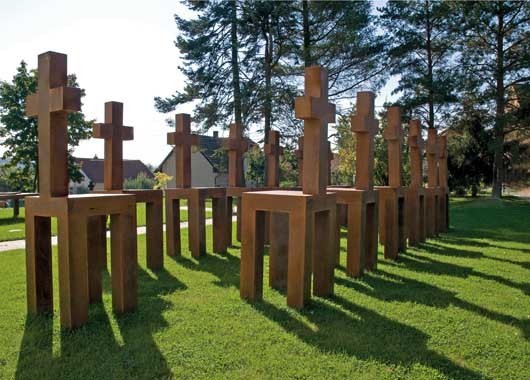
I add to myself that the cross is also the plus sign. It connects the mortal with the spiritual, reality with the otherworldly. I remind him aloud of Ivan Neumann’s observation quoted above: when Kašpar places a sculpture in a meadow (the chairs from the LAST SUPPER, whose backrests form crosses, are a perfect example), the place is suddenly elevated…
“It does not have to be a cross. It can be a stele placed in the landscape, a column, a simple geometric form, or a white Baroque wayside shrine. When you see these objects in the distance, they draw you closer and make you want to examine them. They attract you with a force you cannot explain. A solitary tree on a hill or a tree stump can have the same effect.”
The first two chairs with cross-shaped backrests hold a fundamental place in Kašpar’s work. They became his first tribute to Joseph Beuys, a prominent figure in German and international modern art, and were also the sculptor’s first pair of sculptures. Do not overlook this concept: sculpture plus sculpture, sculpture + sculpture + sculpture… These “unfused groups of multiple sculptures” are characteristic of Kašpar’s work.
“The cross first became a prominent element of my work when I made TWO CHAIRS for Joseph Beuys. I placed them facing one another, imagining that Beuys, who is no longer alive and whose work I admire, would come in, sit down and have a conversation with himself. I realised that when I make a single sculpture, I can walk around it. But when I make two identical or similar sculptures and the viewer stands between them, the energy flowing between the sculptures can enter the viewer, heighten their perception, intensify their experience and draw them inside the sculpture.
“Joseph Beuys had an unusual biography, which I think was embellished somewhat. But that is not important. Among other things, he claimed that his aircraft had been shot down somewhere over Siberia during the Second World War and that Eskimos had saved him from freezing to death. They covered him in fish fat and wrapped him in felt. I once saw his piano on display in Germany, perhaps in Frankfurt, wrapped in felt, which was his means of expression. When I later made my first piano, a grand piano with a raised cross, I thought it could be another tribute to his work.
“But the idea grew unexpectedly in my mind, and for several years I was haunted by the thought of making five pairs of pianos that would form a single whole, with a central space that could be walked through like an avenue. The idea was so absurd that I was beginning to doubt I would ever realise it. My wife, who had to listen constantly to my talk about ten pianos, eventually lost patience, took her savings and said, ‘Here’s the money. Go and make them!’ I bought the materials and managed to build all ten pianos.
“They were first exhibited in the spring of 2010 under the title HOMMAGE À JOSEPH BEUYS at the Nová síň gallery in Prague. When my firefighter friends and I began moving them into the gallery, we discovered that if they had been just two centimetres wider, they would not have fitted through the doors. I had no idea they would premiere there, and I had unknowingly made them to fit the gallery’s doorways! When guests at the opening asked how I had got the pianos inside, I bluffed and told them a helicopter had lifted them through the glass roof. I did not reveal that their legs could be dismantled.
“The artists themselves designed Nová síň for their own use, and its overhead natural light is ideal for sculpture. My solid pianos stand on three legs that taper to a point. Only when we were in the gallery did Dr Neumann and I realise that, because they touch the floor at three tiny points, the pianos appear to float above it in the perfect light, as if they were levitating…”
While five pairs of these objects return home to the farmstead after exhibitions, the monumental MEMORIAL TO THE VICTIMS OF THE IRON CURTAIN has found its place in a landscape marked by totalitarianism, five hundred metres from the western border. There used to be a border guard post here, and reportedly more people attempting to escape to the free world were shot in its vicinity than anywhere else. The site is the former Svatý Kříž border crossing.
“The town of Cheb commissioned the memorial at the initiative of historian and writer Václav Jiřík. It announced a competition, which we won together with architect Jaroslav Šusta. This pair of sculptures, derived from my independent artistic work, is my most significant architectural realisation in recent years.
“Between the almost four-metre-high cubes, the viewer’s attention is drawn to a taut, broken chain, stretched by sheer force of will. I captured the moment when gigantic hands have just torn apart their shackles… One cube bears the inscription ‘To the Victims of the Iron Curtain’; the other lists the names of eighty-two people shot while attempting to cross the guarded state border.
“The memorial was unveiled on 27 June 2006, the 56th anniversary of the execution of Milada Horáková. The unveiling provoked controversy. Descendants of border guards wanted the names of fallen border guards to be included on the memorial as well. Jiří Dienstbier, who unveiled the memorial, addressed the protesting Communists holding banners and asked them: ‘Why are you shouting here? The Charter of Human Rights guarantees everyone freedom of speech and movement. Those people had the right to leave freely. I also served in the border guard nearby, and when we were ordered to shoot, we fired into the air.’ The Communists calmed down only when Bishop Lobkowicz began blessing the sculpture. They fell silent and left.”
Firefighters and Nobel Prizes
A monumental cube. A pair of sculptures depicting supernaturally tall GUARDS. Grand pianos in their actual concert dimensions… Yet Antonín Kašpar is hardly a Hercules himself.
“Sculpture is hard work. It begins with an idea, but working with iron is genuinely demanding, and there is one simple fundamental rule: you can only handle what you can lift. Even though I have learned to use the brilliantly simple and effective inventions of our ancestors, such as levers, pulleys and winches, the fact remains that I cannot move some of my sculptures without help. I cannot get them out of Čisovice on my own, either. When I move sculptures or transport them to exhibitions, the local volunteer fire brigade comes to help me. Sometimes one of them spots me from a distance and turns the corner to avoid being asked to help with another ‘move’.
“That fundamental rule about the limits of physical strength is the alpha and omega of everything I do: what you cannot do yourself, you have to pay for. And I have to earn the money to pay for the help of those around me. There are two options. You can try to make a living exclusively from your independent artistic work from the beginning, but then there is a risk that you will subordinate it to the tastes of your audience. The other path is the one I chose. I earn my living through restoration work (we recently restored the statue of Alois Jirásek in Jirásek Square in Prague, for example), as well as through architectural commissions—work that uses materials and techniques related to my independent sculpture. I then use the money I earn to make whatever I want, freely.
“My dream is to go to the studio every morning and do what I enjoy. I know I would never waste my time; I would appreciate being able to do only that! But unfortunately… Still, this choice has its advantages. Thanks to my craft, I have become the holder of two Nobel Prizes, which surely cannot have happened to many people.”
“Here is how it happened. In 1996, with the consent of the academic’s family, the Ministry of Education granted a secondary school in Prague 5 the honorary name Jaroslav Heyrovský Grammar School. Its headmaster, Vilém Bauer, asked me to make a copy of the rare plaque for the school. As soon as the Heyrovský family lent me Professor Heyrovský’s award, Mgr. Zdeněk Freisleben from the Museum of Czech Literature contacted me because they needed a copy of the Nobel Prize awarded to Jaroslav Seifert. Suddenly I had the ‘Nobel Prizes’ for physics and literature in my possession. I was so afraid someone might steal them that I carried them with me constantly for fourteen days—in my bag. For those two weeks, I really was a double Nobel Prize laureate.”
During the conversation, my eyes wander over the smaller indoor sculptures. In some, I can “read” the expressive imprint of a powerful man’s fist; in another, the emphatic impression of a shoe sole…
“Barcelona is responsible for these works. Barcelona is a city I need in order to live. I need to walk through its galleries and streets and experience a different kind of light. I am convinced that the older a person gets, the more dependent they become on sunlight. The light in Spain puts you in a completely different mood, energises you and brings new, unexpected ideas… A few years ago, my wife Lucie gave me a trip to Barcelona and sent me there alone. She knew I needed to be there by myself.
“As I walked around the city and looked at the paintings of my favourite artist, Tàpies, who has his own foundation and gallery in a former church, it occurred to me that back home, in the gloomier Czech environment, we are always dealing with some great drama in our art. Our work should sometimes be more playful. It was in Barcelona that I came up with the idea of modelling smaller indoor sculptures from clay, something I had rarely done before.
“I did not have the traditional method of modelling in mind. I told myself: You started out as a blacksmith, so you will forge clay! Now I shape clay not only with hammers and mallets, but also with broken pieces of wooden lath and other (non-)tools. To achieve the playfulness and lightness I was looking for, I took inspiration from action drawing, in which you let your mind work freely and allow your hands to move uncontrollably across the paper.”
Pavel Cmíral