
 Čeština
White Paintings
Antonín Kašpar
There is no need to be misled by the provocative prefix anti-, which so often forms various antitheses and, more recently, anti-painting. Let us begin with the fact that the artist’s first name is Antonín, and he therefore signs his paintings ANTI as well. If he is thus genetically or semiologically predisposed, the question is whether the principle at work in his paintings is more anti- or ante-. Setting aside all complex anticipations, the concept of antiphony best captures this predisposition, or the translation of Antonín’s name. As is well known, antiphony is a true counter-song—or, more precisely, alternating singing that traditionally sounds from two places within a church. A solo voice may be answered by a choir in what is called a responsory, or two choirs may engage in a musical dialogue.
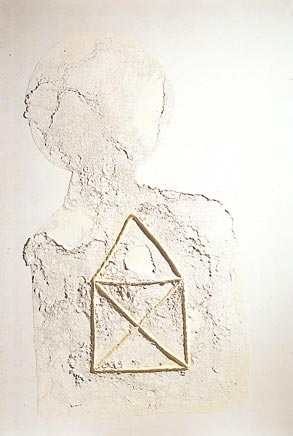
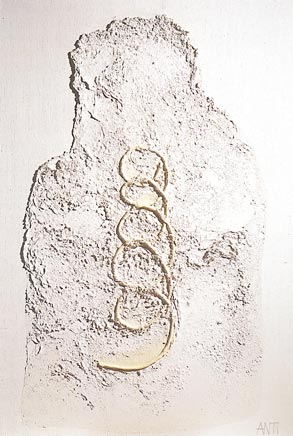
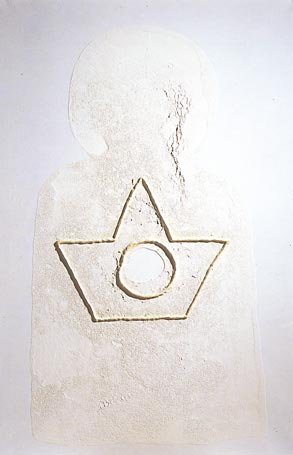
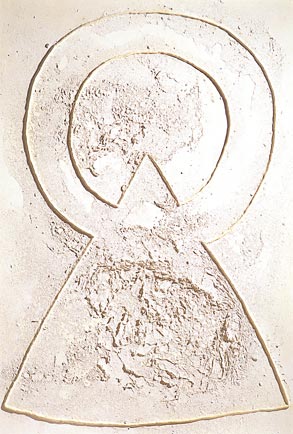
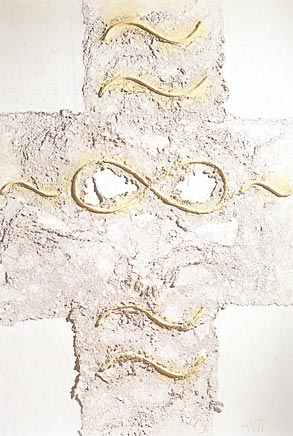
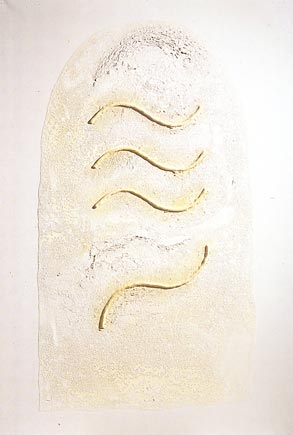
What, then, lies at the heart of this counter-song in Antonín Kašpar’s work? Originally trained as an artistic blacksmith, he worked for many years with metal sculpture. In his architectural commissions, he also used steel, bronze and stone. Yet iron was his primary stimulus, because working with it is highly specific. It must be forged while still red-hot, just as a glassmaker in a glassworks must quickly shape another incandescent material. The more demanding the artistic concept, the more complex the physical action required to realise it. It is a form of timed, action-based art. Over the course of this long practice, the artist created crumpled, figurative metal sculptures, often aggressive in character, with spikes and points. Their forcefulness was heightened by the very brief pause they allowed for philosophical contemplation. The need for a counterbalance eventually became apparent: to no longer be manipulated or constrained by time in his work, to be free from the limitations imposed by the final processing of a material that leaves behind only individual originals, and to escape the single, dirty and noisy environment of the forge. Thus, the counter-song of white became inevitable. In relief canvases and sculptural prints, where layers of white paint accumulate in mass and effect, a kind of technological alchemy gradually gave rise to a sense of responsibility for the white painting—a form that, freed from colour, is in its own way the most difficult of all. Almost amorphous canvases began to emerge, intended to offer viewers a sense of calm, balance, purity and also playfulness as they decipher hidden meanings. These paintings are no longer prickly spears attacking our consciousness; instead, they offer harmony and beauty, from which everyone can take something away according to the strength of their imagination and the depth of their reflection. The atmosphere is almost that of Eastern aesthetics, containing hidden koans with open-ended solutions.
Painting white on white is, of course, seemingly absurd. Malevich once described it as a dimension of absolute sensitivity, while Fontana sought to give it physical form by cutting into the surface of the white canvas. Manzoni, in turn, sought to negate it in his “Achromes” through the “infinite line” of a continuous drawing gesture, in which physical space was often created by gathering and folding the canvas as a material. In Asia, white is therefore often understood as emptiness, made visible either through the use of its opposite, black, or through the broader practice of revealing contrasts—in shapes, asymmetry or materials. Antonín Kašpar, however, discovers an entire range of tones within white. It takes considerable self-discipline to remain within the reality of white: neither to settle into the transcendental nor to abandon the tangible world. The modelling clay with which he shapes his relief-like personal signs is coated in white paint, yet it contains beeswax, allowing grease to seep through or the paint to wear away. The alchemy of white oil paints used as a background also requires binders, making it different from simple white, which provides yet another fundamental ground for this layered shaping. The entire surface is then sprinkled with plaster, beneath which the painting often rests for several days, allowing the surface to mature into a textured material structure. Even so, the drawing from the first pictorial layer often eventually shines through. The artist does not seem to mind. He simply seeks to keep his experimentation within the control of his intention and to distinguish the individual layers according to their meanings. Unlike rapidly solidifying metal, the gradually crystallising texture of paint often offers him a welcome surprise.
The figurative personal signs that emerge within the texture of the white paintings most likely derive from his early experience with figurative metal sculpture. Across the picture plane, they generally form a background, and only rarely does their outline merge with the inner life of the figure. In most cases, the figures—or the objects on which they are thinking—express fundamental states of human feeling or thought. The movements of the mind, life, energy, associations or other matters worth contemplating are shaped in relief through simple curved or straight lines. Sometimes this mental and psychological movement follows a spiral and ends, for example, in a square. Sometimes it is enclosed within triangles tilted at different angles. Occasionally, the background contains a non-figurative motif, such as an oval or an egg, within which a linear maze or ladder appears. The whole remains clear, yet full of multiple meanings. In one background, the artist’s young son imagined a little hand-and-foot figure or a small house he would one day like to build. In another, a child in the shape of a cross emerges from a white womb, arms outstretched like a Phoenix.
Antonín Kašpar’s personal signs continue his earlier graphic experiments, pressed into a raised white film in a kind of blind embossing and endowed with a bird-like script. This is an imaginary writing system, yet it is connected to our archetypal experience of writing in images, whether Chinese characters or the cord-based writing of primitive African tribes. In any case, it is a pre-civilisational pictography, later transposed into architectural forms as well. This primary experience determines the mood of the paintings, which are further shaped by the effect of light when they are installed. Here, the fall of light transforms our response to white, from everyday experience to the mystical. It should be remembered that the artist is accustomed to listening to music while working. He also deeply admires Tàpies and Miró, yet his own sensibility is thoroughly contemporary. The counter-song of whites within white, the figurative-abstract morphology of his chosen signs—alternating between seriousness and humour, emotion and reflection—and the expression of a general nostalgia for history all point to an awareness of shared authorship in the present day. His paintings also aptly express the conceptual tension between ante- and anti-, which he anticipates as a question, a problem and a mode of existence for painting today.
Vlasta Čiháková – Noshiro